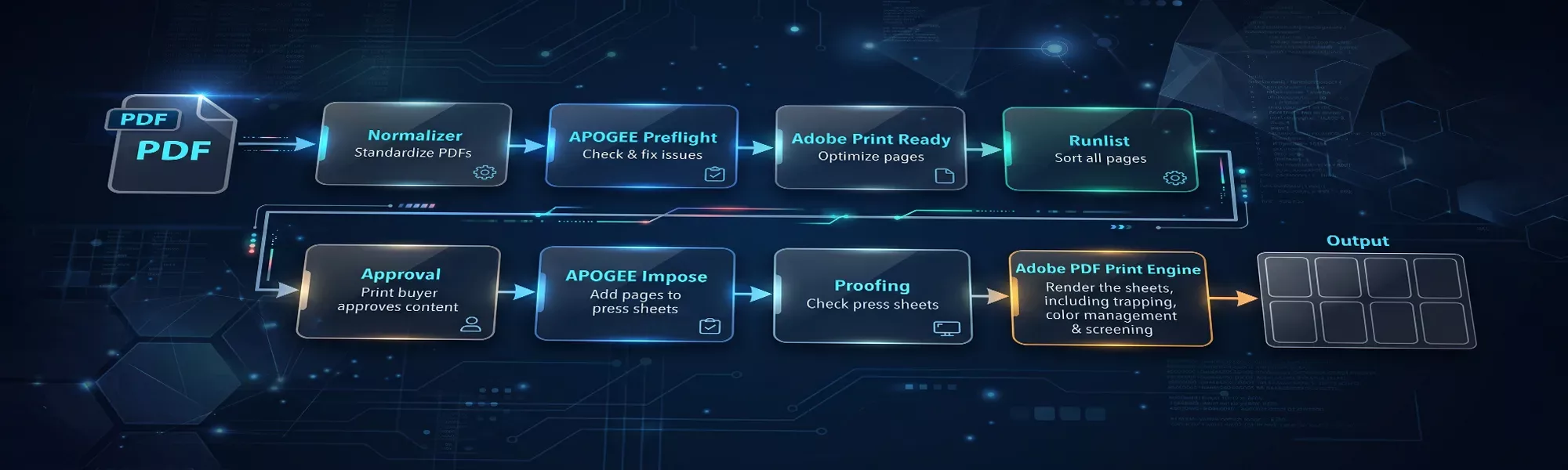
The next bottleneck in print production isn't your press or finishing equipment
Online ordering, shorter production runs and increasing file complexity are putting pressure on prepress departments. Every day, printers receive files from a growing range of sources, many of which were never designed for professional print production. At the same time, experienced prepress operators are becoming harder to find.
For many print service providers, the question is no longer how to print more jobs. The question is how to process more files with fewer manual touchpoints while maintaining consistency and quality.
The challenge starts before a file reaches production

For decades, Adobe PDF Print Engine has been one of the industry's most important technologies. It serves as the rendering engine that transforms PDF content into high-quality printed output, helping ensure color accuracy, transparency handling and predictable results across a wide range of print applications.
But while the RIP remains critical, many of today's production challenges emerge before a file ever reaches that stage.
Web-to-print platforms, online ordering portals and digital-first content creation have dramatically increased the number of files entering print workflows. At the same time, experienced prepress specialists are becoming harder to find and more difficult to replace.
Print quality has always depended on what happens at the RIP, but increasingly it depends on what happens before a file ever gets there. Print Ready SDK, part of Adobe Print Services, is built to meet files earlier, correcting, enhancing, and optimizing them before they reach production, so printers spend less time fixing problems manually and more time keeping jobs moving.
Mark Lewiecki, Senior Product Manager - Adobe Print Technologies
Why intelligence is moving upstream
Traditionally, prepress teams manually correct and optimize incoming files before sending them to production. While this approach remains effective, it can become difficult to scale in environments processing hundreds or thousands of jobs every day.
This is where Adobe's Print Ready introduces a new layer of pre-RIP intelligence. Instead of focusing only on rendering files for output, Print Ready helps analyse, correct, enhance, and optimize PDF files before they enter production workflows.
The goal is not simply to identify issues. The goal is to improve incoming files so they can move through production more efficiently and with less manual intervention. This becomes increasingly important in environments where hundreds or thousands of jobs arrive through automated ordering channels every day. For ECO3, that shift lines up with Adobe's vision for a smarter, more automated production print experience, where files are corrected and optimized long before they reach the press.

Integration is key: extending the power of Apogee
For ECO3, Print Ready is more than just an interesting new technology. It's a concrete step toward Adobe's vision for a smarter, more automated production print experience, brought directly into Apogee.
As Adobe expands its technology beyond the RIP, ECO3 is working closely with Adobe's development teams to ensure these new capabilities integrate seamlessly into future generations of Apogee. By combining proven rendering technology with intelligent file preparation, printers can reduce manual intervention, improve production readiness and move one step closer to fully automated workflows.

What’s coming next?
Print Ready highlights an important shift taking place across the print industry: more intelligence is moving upstream in the workflow, part of Adobe's vision for a smarter, more automated production print experience.